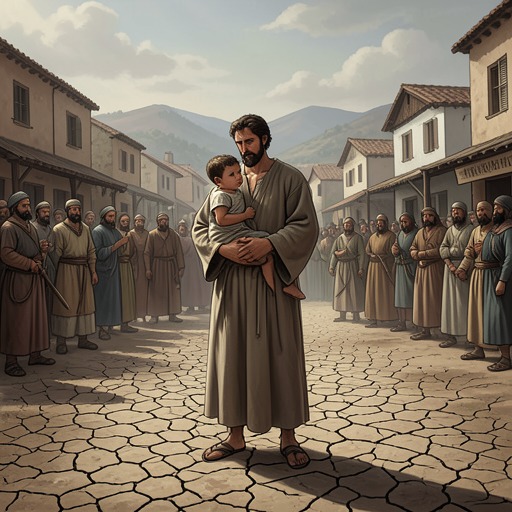
Long drought and famine in the rainmaker’s village
The Glass Bead GameThe prolonged drought and famine in the rainmaker’s village expose the limits of ritual power while testing what service can mean when a community’s survival is at stake. Across two years of crop failure, Joseph Knecht cannot make rain, yet he helps the tribe endure hunger, finds water, and protects its stores; when drought returns after a period of recovery, he offers himself as a sacrifice and prepares his son Turu to succeed him.
The First Two Years of Famine
The first crisis began with sowing repeatedly postponed and a sequence of misfortunes that nearly destroyed the crops. The village starved, and Knecht, its rainmaker, starved with it. His first achievement was to survive without losing all credibility, enabling him to help the tribe face the catastrophe with humility and some composure rather than simply collapse into despair.
The next year brought no reprieve. A hard winter killed many villagers; summer dried and cracked the common land, and mice multiplied as the harvest failed again. Knecht’s solitary conjurations and sacrifices proved as ineffective as the public ceremonies, drum choruses, and processions conducted by the whole community. As the evidence mounted that he could not make rain, he endured two or three weeks alone against the frightened and angry village, its hunger, and its belief that sacrificing the rainmaker could appease the powers.
His response joined submission to practical care. Knecht did not resist the people’s sacrificial idea and offered himself, but the immediate account of the crisis records his offer as a means of holding his place among the villagers, not as a sacrifice carried out then. Meanwhile, he labored to relieve distress, repeatedly locating springs and trickling streams. He also prevented the villagers from slaughtering all their livestock and supported the tribal mother, who was weakening under the strain. Through advice, threats, magic, prayer, example, and intimidation, he kept her from abandoning the community to disorder.
The two years nearly cost Knecht his life, but they ended with his standing strengthened among the few responsible people able to judge him. The account draws a distinction between their considered trust and the judgment of a thoughtless crowd. In calamity, his usefulness lay not in mastery of the weather but in his devotion to matters beyond himself: observing, venerating, serving, and being prepared to sacrifice.
Drought Returns
A later crisis repeats the failure of the rains under harsher circumstances. After the tribal mother’s death, the new mother requested an elaborate sowing ceremony: her elderly predecessor’s replacement scattered the first grain over the common land while her sisters carried grain pouches at her sides. Knecht felt relief when the rite was done, but the festive beginning gave way to an exceptionally merciless year.
Wintry frosts returned, spring weather swung between extremes, and summer brought the worst drought anyone could remember. The crops grew only thinly, the smaller brooks dried, and the village pond dwindled to a muddy marsh thick with dragonflies and mosquitoes. The earth split into deep cracks beneath weeks of white, blazing heat. Clouds gathered without yielding rain; brief showers were followed by a parching east wind, and lightning struck trees whose dry crowns caught fire.
Knecht interpreted the disaster through the villagers’ supernatural understanding of weather and danger. He told Turu that the falling stars had begun the trouble, that all the demons were against them, and that the crisis would likely cost him his life. His words joined a forecast of personal danger to explicit instructions for what should follow: Turu was to assume the rainmaker’s office immediately if Knecht were sacrificed, have his body burned, and scatter the ashes over the fields. Knecht predicted a hungry winter but a better harvest the following year, when the villagers would welcome their new, young rainmaker.
Sacrifice and Succession
As drought deepened, despair took hold. Maro incited the villagers, who shouted threats and curses at Knecht. Ada fell ill with vomiting and fever, while processions, sacrifices, and long drum choruses failed to bring relief. Knecht led the ceremonies because they were his duty; once the people dispersed, he was left alone and shunned. He knew Maro had already pressed the tribal mother to demand his death.
Knecht took the last step himself, acting for his own honor and for Turu’s future. He dressed his son in the ceremonial robes, brought him before the tribal mother as his successor, and offered his own life. After studying Knecht, she nodded and consented. The sacrifice was carried out that same day, converting the customary threat against an ineffective rainmaker into an orderly transfer of office: Turu was visibly prepared to take his father’s place.
The procession to the woods gathered the village’s leaders, the tribal mother and two of her oldest sisters, Maro, the chief of the drum corps, and the villagers able to attend; many were sick with dysentery, and Ada was gravely ill. Turu, dressed in the robes and tall fox-fur headdress, nearly collapsed from heatstroke. The villagers carried stone axes to cut wood for the funeral pyre. Knecht had chosen a large circular clearing as the place of sacrifice. There, the dignitaries formed a ring around him and the larger crowd stood beyond them. The procession was silent and dejected, and no one insulted the old rainmaker. After an uncertain, embarrassed silence, Knecht himself spoke.
Meaning of the Recurring Crisis
The drought is not a single test but a repeated collision between the village’s dependence on ritual authority and the rainmaker’s inability to control the weather. In the earlier famine, Knecht’s refusal to oppose the sacrificial belief coexisted with practical interventions that preserved water sources, livestock, and communal leadership. In the later crisis, that accommodation reaches its extremity: he offers himself, but also ensures that Turu is installed as successor and gives him instructions intended to protect the community’s seed grain and future harvest.
The episodes distinguish ceremonial efficacy from social responsibility. The rites do not produce rain, yet the rainmaker’s office still carries duties that cannot be abandoned when they fail: leading the people, facing their fear, protecting what remains, and accepting the cost they believe necessary. Knecht’s return to sacrifice after surviving the earlier famine makes the recurrence especially stark. His authority is at once discredited by the failed weather and reaffirmed through the care, composure, and succession plan with which he meets the village’s desperation.